Rail Signalling Model Room

A live railway, scaled down to the size of a room.

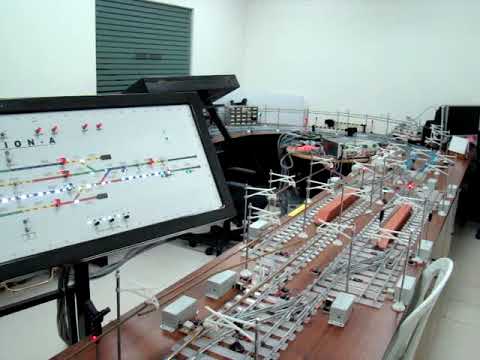
Point machines, track circuits, axle counters and electronic interlocking working together exactly as they do on a real line — with onboard ATO, ATP and manual driving over secure radio. One platform, reconfigured for Metro networks or Indian Railways mainline operations.

2004Award-winning origin, now on FPGA
3Interlocking logics on one platform
2Proven installations — Hyderabad & DMRC

Two networks, one model

Built for Metro. Rebuilt for mainline.

The same working core — reconfigured station by station, yard by yard, for the network it needs to represent.

Configurations shown are illustrative; every install is scoped to the customer's own network.

ACTIVE / METRO MODEL ROOM
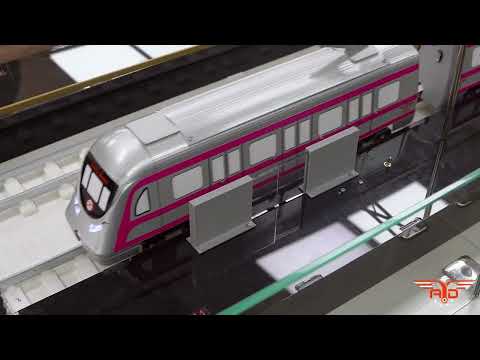
Metro Model Room in operation
Watch / Metro

Mass transit & urban rail

Metro Model Room

Elevated, underground and at-grade stations, short-loop operations, and ATO/ATP-driven train control — the full range of a modern metro network. Reflects the operational realities that matter to a metro: tight headways, automatic train operation, and interlocking logic proven at DMRC’s own Rail Academy.

Elevated · underground · at-gradeStation types
ATO + ATP + manualTrain control
DMRC Rail AcademyProven install

01 / 02 — configurations shown are illustrative.

Under the hood

What the model physically replicates.

Every component is integrated, wired and driven by the same logic as a live installation — not a static diorama.

01

Signalling hardware

Point machines, signals, track circuits, axle counters and AFTC — trackside kit built to scale and fully wired.

02

Logic layer

Electronic interlocking integrated end-to-end with the physical hardware, running the same route logic as the field.

03

Train controls

Onboard ATO, ATP and manual driving over secure radio — trainees accelerate, brake and drive as they would in service.

04

Station environments

Elevated, underground and at-grade layouts, so trainees meet every configuration a real network can throw at them.

Interlocking, demonstrated

Three philosophies. One platform.

Trainees move between interlocking systems without ever leaving the room.

01

Route Relay Interlocking

Classic relay-based route setting, locking and releasing — still the backbone of much of the network.

02

Panel Interlocking

Centralised panel operation for compact station control, with the same route logic underneath.

03

CEMENTS / British-type

The interlocking philosophy behind many legacy and modern installations, run side by side with the others.

Track circuiting is covered the same way — DC track circuits, AFTC and axle counters — alongside route setting and releasing, approach locking, emergency release, and short-loop operations specific to metro systems.

Break it on purpose.

Fault injection / live response

Break it on purpose.

Fault simulation

Watch the interlocking logic hold the line safe.

Trainees can drop a track circuit or disturb a point-machine feedback and observe, in real time, how the interlocking responds. Abstract safety principles become something you can trigger, watch and repeat — a controlled, risk-free rehearsal for failures no one wants to meet for the first time in the field.

Cross-check before you build.

Design verification

Cross-check before you build.

Beyond training

A working cross-check for control tables and scheme plans.

Engineers verify control tables, scheme plans and wiring diagrams against a physically operating system — catching design gaps before they reach a live line, and building conceptual clarity a drawing alone can’t give. OEMs use the same model to train their own design engineers and to demonstrate signalling capability to prospective clients.

Training curriculum

What trainees actually learn.

01Track circuiting — DC track circuits, AFTC, and axle counters.
02Route setting, locking and releasing.
03Approach locking and emergency release.
04Short-loop operations specific to metro systems.
05Fault simulation — dropped track circuits, disturbed point-machine feedback — and the interlocking’s real-time response.

Built for

Two kinds of teams.

Rail academies

Training institutes

New mainline and mass-transit professionals build signalling competence before ever touching a live system — proven at the DMRC Rail Academy.

OEMs & service providers

Design & demonstration

Train design engineers who arrive with little domain knowledge, and showcase signalling capability directly to prospective clients.

Proven, not theoretical

Installed where training happens.

From industry training centres to Delhi Metro's own academy, our railway models are in daily use, teaching signalling to the people who will run the network.

Since 2004

Award-winning origin

Built from hundreds of discrete logic ICs as a final-year project, achieving full SSI functionality and winning multiple national awards — since redesigned on FPGA.

Science Limited, Hyderabad

Live installation

A working installation used for signalling training and demonstration, proving the model’s effectiveness in a real training environment.

The model in operation at Science Limited, Hyderabad
Watch / Science Limited, Hyderabad
DMRC Rail Academy

Live installation

An installation at Delhi Metro’s own academy — training the professionals who will run one of India’s busiest metro networks.

The model in operation at DMRC Rail Academy
Watch / DMRC Rail Academy

Why Aryavart

Industry-grade signalling. Model-room scale.

Not a diorama with lights — a working control system engineers would recognise.

Authenticity

Realistic replication

Control panel operations, displays and functions identical to real industry systems.

Innovation

Industry-first SSI

The industry’s first functional rail signalling model integrated with custom Solid State Interlocking for model trains.

Versatility

Training, sim & promotion

One platform for training, design verification, field-equipment demonstration and brand promotion.

Credibility

Award-winning origins

Recognised by industry leaders since its earliest, ICs-and-relays incarnation.

Have a model room in mind — Metro or mainline?

Tell us the network, the stations and the training outcome you need, and we’ll scope a configuration around it.

Start a conversation